Skilled Volunteer Platforms Compared for Nonprofits
Catchafire, Taproot Plus and mentored apprentice programs compared for small nonprofits, on cost, scoping, who reviews the work and what happens when a volunteer leaves.

- Skilled volunteer platforms make matching fast, and projects still succeed or fail on scope, review and hand-over.
- Catchafire leads with pre-scoped projects through sponsored memberships, while Taproot Plus is free and flexible from a single session up.
- Mentored apprentice programs suit systems a nonprofit must run for years, because a mentor checks the work before hand-over.
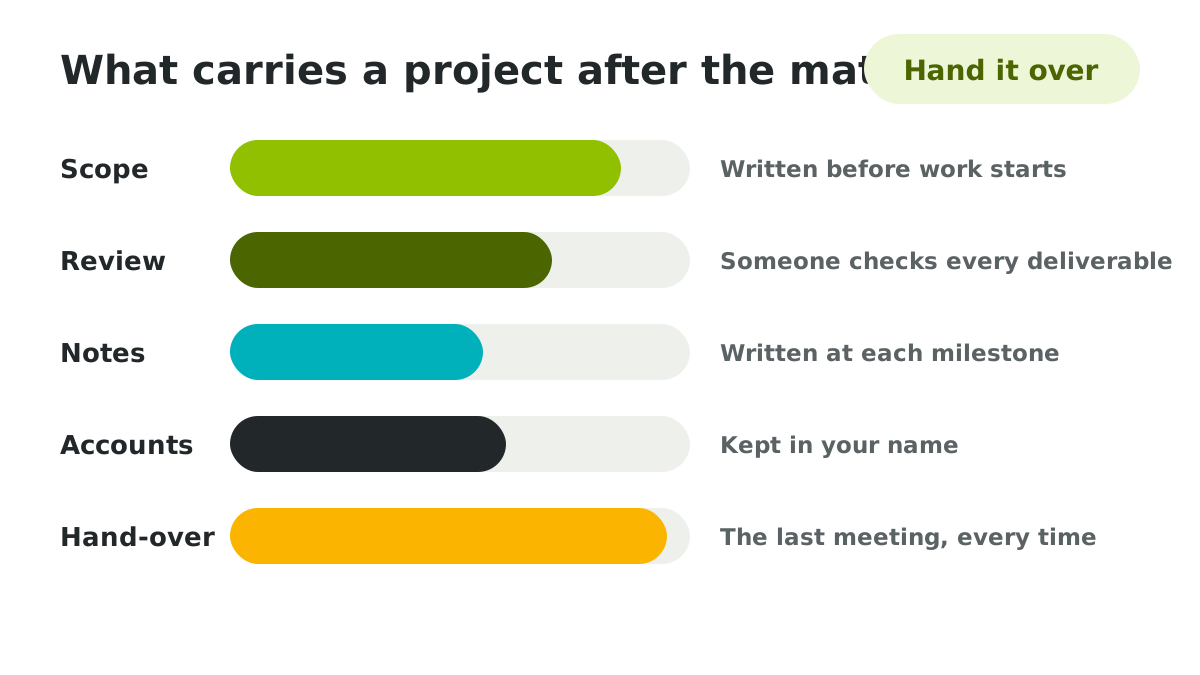
Skilled volunteer platforms connect a small nonprofit with professionals quickly, and the project still succeeds or fails on scope, review and hand-over, so choose the platform whose model covers those three things for the work you need.
Remote skilled help is now a normal part of volunteering. 18 percent of formal volunteers served completely or partially online in the most recent national data, and platforms have grown up to match nonprofits with that talent. The matching part works well. What varies is what happens after the match. That's when one busy professional becomes responsible for finishing a project your team depends on.
The comparison below sets Catchafire, Taproot Plus and mentored apprentice programs side by side on how they work, what they cost and how they support a project through to the end. If you'd like to see the mentored model up close, request a project to start.
What skills-based volunteering is and how it works
Skills-based volunteering means a professional gives their working skills, such as marketing, design, data or finance, to a nonprofit for free. Instead of serving meals or sorting food at a pantry, they complete a defined piece of work or give expert advice, usually remotely.
Most platforms follow the same pattern. The nonprofit describes what it needs, the platform shows the request to volunteers with matching skills, the two sides meet and agree on the work, and the volunteer delivers it over a few weeks. A literacy program might post a request for a volunteer recruitment flyer and a short email sequence, match with a marketing manager who has evenings free and have both finished within a month.
The model's strength is speed and range. Its weakness is that everything rests on one person's availability, which is why the details of each platform matter.
It also asks something of the nonprofit. Someone on your team has to write the request, meet the volunteer, answer questions and review the work. Budget a few hours across the project for that, and the result will be far better than a request posted and left alone.
What varies is what happens after the match.
How Catchafire works for a small nonprofit
Catchafire is an online skills-based volunteering platform where nonprofits choose from a menu of more than 150 pre-scoped projects, each running from about 5 to 50 hours, or book one-hour calls with experts. Nonprofit advisors help organizations pick and scope the right projects.
Access usually comes through a funder. Many nonprofits join through a membership sponsored by a foundation in their area, and others can apply for a free membership when a spot opens. A small animal rescue invited by its community foundation could post a social media calendar project, review volunteer applications and choose the best fit within a week. The pre-scoped project menu does a lot of the scoping work for you, which helps teams that have never briefed a consultant before.
The trade-off is availability. If no sponsor covers your area, you may wait for a free membership spot, so check with your local community foundation before you plan a project around it.
How Taproot Plus works for a small nonprofit
Taproot Plus is a free platform from the Taproot Foundation that connects nonprofits with skilled volunteers for real-time advice sessions or multi-week projects. It's open to nonprofits in Canada, the United States, the United Kingdom, the European Union and India, with no sign-up cost.
Nonprofits create a profile, describe the support they need and match with a volunteer consultant. A youth sports charity could book a single session to get advice on its board recruitment plan, then post a longer project for a website refresh. The flexibility suits teams that want to start small, and the free access removes the question of finding a sponsor.
Taproot also publishes guides, templates and webinars, which help a nonprofit prepare a stronger request before the first match.
The main difference between Catchafire and Taproot
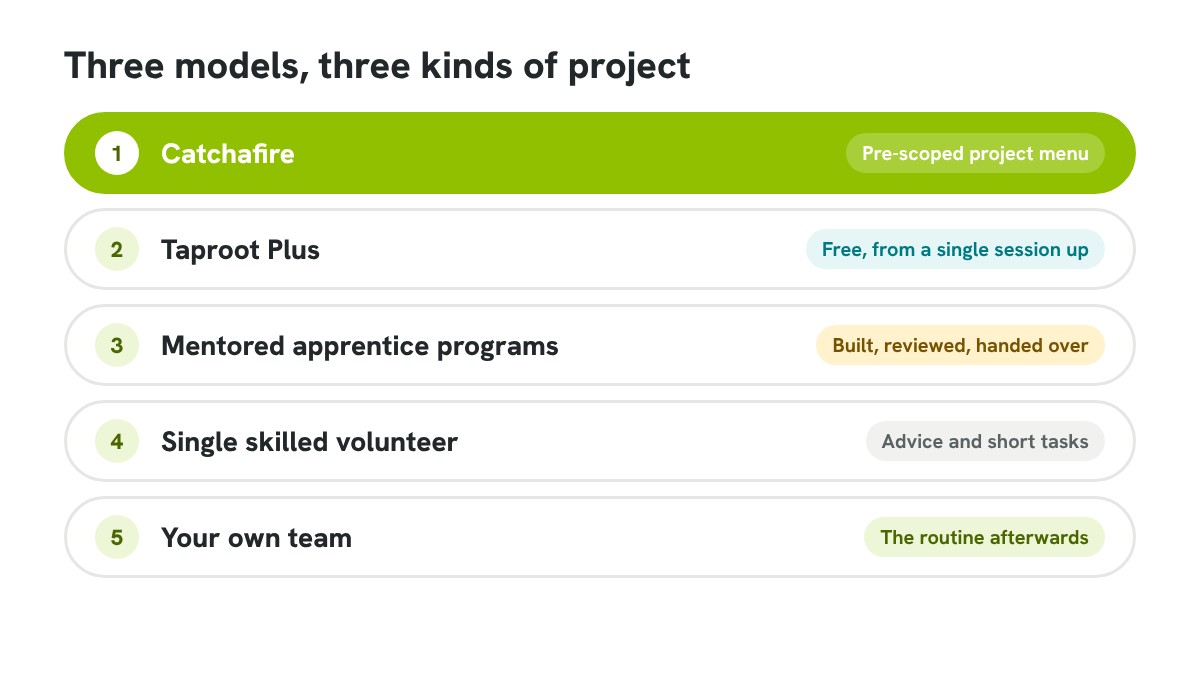
The main difference between Catchafire and Taproot is how access and scoping work. Catchafire leads with a menu of pre-scoped projects and usually reaches nonprofits through funder-sponsored memberships, while Taproot Plus is free to join and lets nonprofits describe their own need, from a single session to a multi-week project.
| Question | Catchafire | Taproot Plus | Mentored apprentice programs |
| What it costs a nonprofit | Free through a sponsor or a free membership when spots open | Free to join and use | Free, delivered in kind |
| How work gets scoped | Chosen from a menu of pre-scoped projects | Described by the nonprofit with platform guidance | Scoped with the nonprofit by the program before work starts |
| Who does the work | One matched professional volunteer | One matched volunteer consultant | Apprentices, with an experienced mentor |
| Who checks the work | The nonprofit reviews it | The nonprofit reviews it | A mentor reviews every deliverable first |
| Typical length | About 5 to 50 hours, or a one-hour call | A single session or a multi-week project | A few weeks per engine, with a hand-over |
| Best for | Teams that want a ready-made project menu | Teams that want free, flexible access | Teams that want a working system handed over |
Neither platform is better in general. A nonprofit with a funder sponsor and a common need will move fast on Catchafire. One with no sponsor or an unusual need will find Taproot Plus easier to start with.
Where mentored apprentice programs fit
Mentored apprentice programs fit projects where the nonprofit needs a working system built and handed over, and can't spend much time reviewing the work. Apprentices do the build while an experienced mentor checks each deliverable, so quality doesn't depend on one volunteer's experience.
The time has real value even when the nonprofit pays nothing. Independent Sector puts a volunteer hour at $36.14, so a forty-hour project is worth more than a thousand dollars of skilled time. Mentored programs add a second layer of review on top of that time, which is what makes the result safe to hand over. Layer Cake Foundation works this way, and its impact stories, such as the analytics and Ad Grant work for a global network supporting women in technology, show what that hand-over looks like.
The trade-off is pace. A mentored project moves at the speed of review, so it suits systems you'll run for years more than a flyer you need by Friday.
Mentored programs also tend to take fewer projects at once, since each one needs a mentor's time. Apply early if you have a deadline in mind.
What happens when a skilled volunteer leaves halfway
When a volunteer leaves halfway, the project usually stalls unless the work was documented as it went. Life changes, new jobs and busy seasons all pull volunteers away, and a half-finished website or campaign can sit untouched for months.
- Keep all work inside your own accounts from the first day
- Ask for short written notes at each milestone
- Break larger projects into stages that are useful on their own
- Agree a check-in date halfway through the project
- Know which platform or program contact to call if the match ends
Platforms can help you rematch, and mentored programs can reassign the work within the team. Either way, documentation is what lets someone else pick up where the last person stopped.
Documentation is what lets someone else pick up where the last person stopped.
Choosing the right skilled volunteer platform for your project
Choose by the job. A common, well-defined project with a funder sponsor suits Catchafire. A first step, a single advice session or an unusual need suits Taproot Plus. A system your team must run for years, built and checked before it's handed over, suits a mentored program.
Many nonprofits will use more than one over time, and that's healthy. What matters most is the same everywhere. Write a clear scope, keep the work in your own accounts and make sure the last meeting is a hand-over. Mentored apprentices at Layer Cake Foundation work exactly that way, and the same three habits will improve any skilled volunteer project you take on.
Start with the project you'd be most relieved to have finished, and pick the model that will get it to a proper hand-over.