Marketing a Nonprofit With a Team of One
A practical guide to running nonprofit marketing with one staff member, covering which channels to run first, a two-hour weekly routine, where AI helps and how to bring in skilled help.

- A nonprofit with one marketer gets more from email and a few clear website pages run every week than from posting on every platform.
- A fixed two-hour weekly routine, with templates and a running email document, keeps marketing steady through busy seasons.
- Outside help pays off when it builds one working engine and hands it over, so the team runs fewer things and runs them well.
A nonprofit with one person doing the marketing gets the best results from two channels run every week, a routine that fits inside a few hours, and help that ends with something the team can keep running.
Most nonprofits are small, and their marketing is smaller still. About 88% of nonprofits spend less than $500,000 a year on everything they do, from programs to rent to salaries, so marketing usually lands on one staff member who also writes grants, answers the phone and runs the volunteer schedule. That person can't keep up with advice built for a department of five. They need fewer channels, shorter routines, a clear sense of what to leave alone and skilled help that hands back a working system.
The good news is that a single person with a steady plan will outperform a bigger team that posts everywhere and finishes nothing. Consistency is what supporters notice, and it's the one thing a small team can control. What follows is the plan we'd hand to anyone carrying a nonprofit's marketing alone.
What marketing a nonprofit with one person actually involves
Marketing a nonprofit with one person means choosing a small set of jobs and doing them on a schedule. Those jobs are telling supporters what changed because of them, helping new people find you when they search, and asking for support at the right moments. Everything else is optional until those three run reliably.
Picture the communications lead at a food bank who also books volunteer shifts. Her week has maybe four hours for marketing, and they get eaten by whatever feels urgent, usually a social post nobody planned. When she names three jobs and gives each one a fixed slot, the same four hours produce a monthly update, a refreshed program page and a clear ask before a busy season. The shift is from reacting to running a short list. It also makes the work visible to the executive director, who can see what got done and what got dropped on purpose.
Why most nonprofit marketing advice assumes a full team
Most advice on marketing for nonprofits comes from agencies, software companies and large organizations, and each of them writes for a team with a content calendar, a designer and an analyst. The tactics are sound. The staffing they assume is the problem, because a plan built for five people collapses when one person tries to run all of it.
A typical guide will recommend posting daily on four platforms, sending two emails a week, running a podcast and refreshing the website quarterly. A single staffer who tries to follow that list ends up doing each item badly for a month, then quietly stopping. The supporters who followed along see a burst of activity followed by silence, which reads as an organization in trouble.
Treat outside advice as a menu and order only what you can serve every week for a year. If a tactic needs more than an hour a week to keep alive, it's a project for later, or a job to hand to someone else.
Treat outside advice as a menu and order only what you can serve every week for a year.
The two channels a team of one should run first
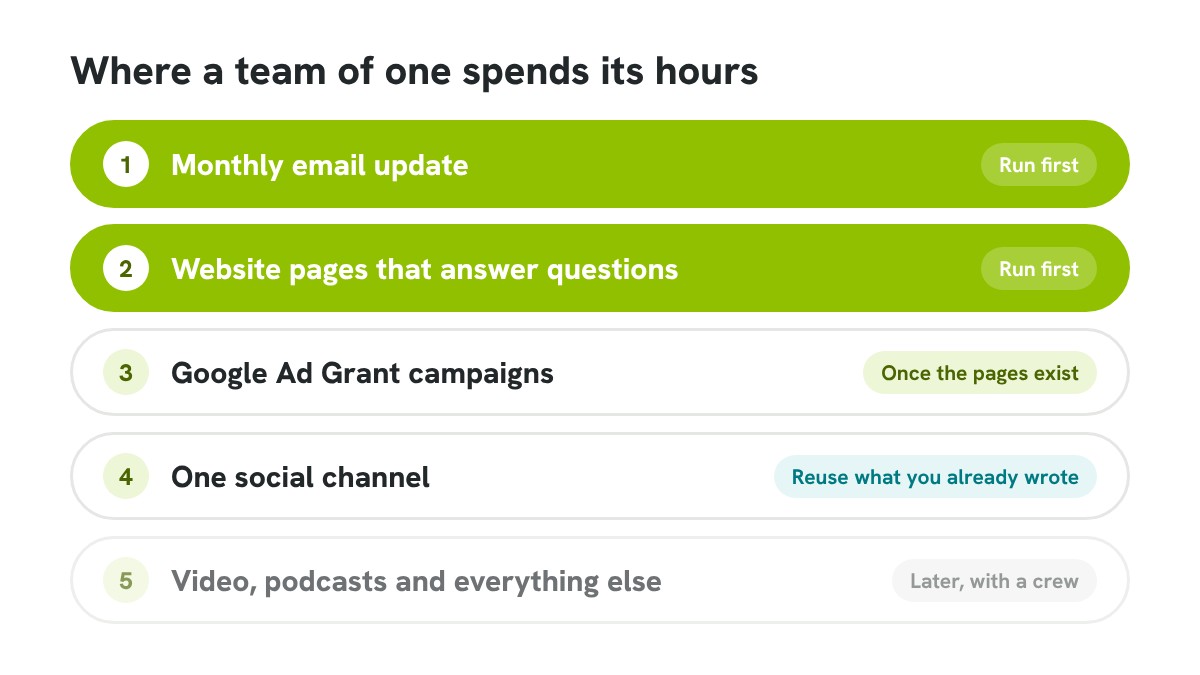
A team of one should run email and its website first. Email reaches people who already said yes, and your list belongs to you. The website is where searchers, funders and journalists land, and a well-built page keeps working on weeks when you publish nothing. Social media matters, though most digital marketing for nonprofits overweights it, and for a team of one it comes third.
Consider a literacy program choosing where its first hours go. A monthly email to 800 supporters and two strong website pages will raise more, and recruit more volunteers, than a daily posting habit that reaches a fraction of followers. Social then becomes a place to share what the email and website already hold.
| Channel | Weekly time for one person | What it gives back |
| Monthly email update | About one hour a week, spread across the month | Repeat gifts and volunteers from people who already know you |
| Website pages that answer questions | About one hour a week on one page at a time | New supporters and partners who find you through search and AI answers |
| Google Ad Grant campaigns | Under an hour a week once the account is built | Free search ads that send ready visitors to your best pages |
| One social channel | About thirty minutes a week reusing email and website content | Visibility with followers and partners between emails |
| Everything else, such as video and podcasts | Hours a week that a team of one rarely has | Reach that only pays off with a steady crew behind it |
How to keep a monthly email going with one person
Keep a monthly email going by fixing its format and building it as the month goes. Use the same four parts every time, a short story, one number, one update and one ask. Collect material in a running document, then spend an hour at month end assembling and sending it.
Email is also where most supporters are won or lost. Across the sector, only 43.3% of donors who gave in 2024 gave again in 2025, which means more than half of last year's supporters quietly walked away. A monthly note that shows what their gift did is the cheapest way a small team has to change that number.
A youth sports charity can do this with a coach's quote, the number of kids who played this season and a link to register a volunteer. That takes twenty minutes to write once the parts are waiting in the document.
Why your website should answer questions before it tells stories
Your website should answer the questions people type into Google and AI assistants before it tells your story. Searchers want to know what you do, who you serve, where you work and how to help. Pages that answer those plainly get found, and the story then has someone to read it.
Many small nonprofits open their homepage with a mission statement and a slideshow, then bury the program details three clicks deep. A parent searching for after-school programs nearby never finds them. One page per program, each with who it serves, how to join and what it costs, will do more for discovery than a full redesign.
AI assistants now answer many of these searches directly, and they pull from pages that state facts clearly. Short, specific answers near the top of each page help you appear in both places. Work through one page a month and the whole site improves within a year.
Where a Google Ad Grant fits for a small team
A Google Ad Grant fits a small team as a monthly budget of free search ads that points people to the website pages you've already improved. It's worth applying for once those pages exist. The catch is upkeep, because the grant has rules on account quality, and accounts left alone lose it.
Plenty of nonprofits win the grant, launch one campaign and never log in again. The Food Bank of Alaska held a grant that wasn't being used until Layer Cake Foundation built Ad Grant campaigns for the team and trained them to run it. Once campaigns are structured around real programs, the weekly check takes less than an hour. The setup is the hard part. If nobody on staff has built search campaigns before, get that first build done with experienced help, then keep the routine yourself.
How to build a weekly marketing routine in two hours
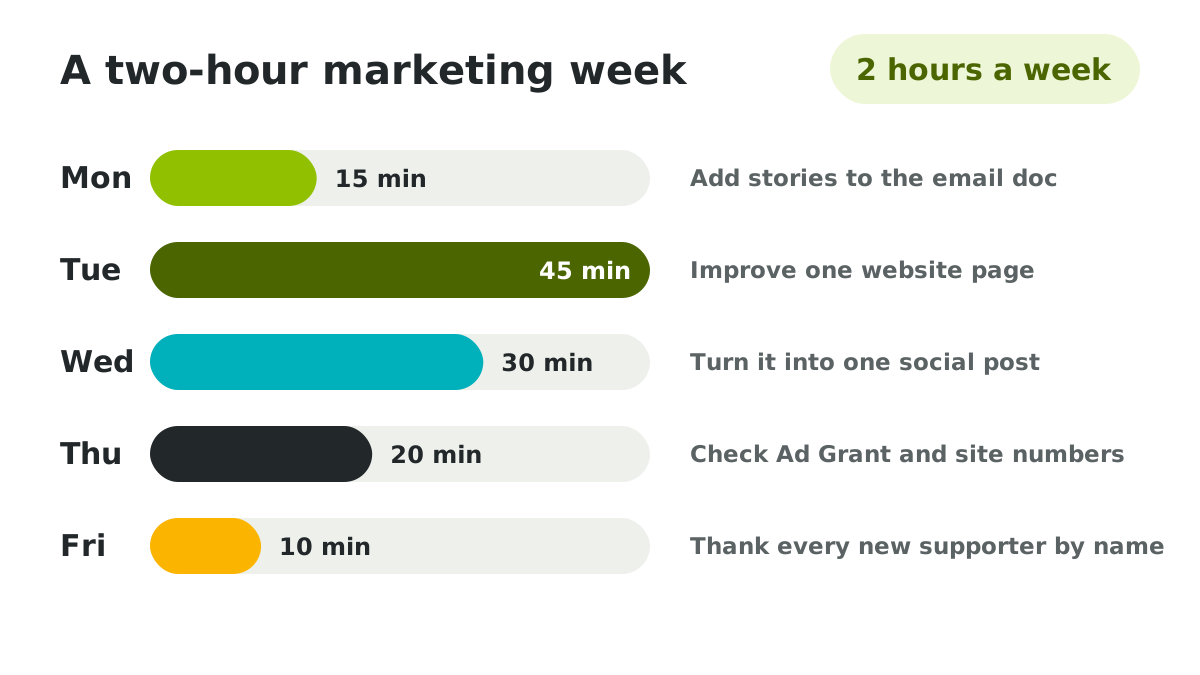
Build a weekly routine by giving each channel a fixed slot and a single task, then protecting that time on your calendar. Two hours is enough when the work is planned ahead and nothing starts from a blank page. The routine below suits most small nonprofits, and the planner after it fits the routine to the hours you actually have.
- Monday, fifteen minutes adding this week's stories and photos to the running email document
- Tuesday, forty-five minutes improving one website page or writing one new answer
- Wednesday, thirty minutes turning that page or story into one social post
- Thursday, twenty minutes checking the Ad Grant account and website numbers
- Friday, ten minutes thanking every new supporter from the week by name
An animal rescue running this routine stopped scrambling before every adoption event, because the event page, the email mention and the post were already in motion weeks ahead. The calendar did the remembering.
Skipped weeks will happen. Keep the Friday thank-yous no matter what, because they protect the relationships every other task depends on.
Keep the Friday thank-yous no matter what, because they protect the relationships every other task depends on.
Which marketing tasks to hand to AI and which to keep
Hand AI the first drafts, the reformatting and the summaries, and keep the judgment, the stories and the relationships for yourself. A tool can turn a program report into a draft email or a post in seconds. It can't know which family agreed to share their story, or which phrasing your community finds respectful.
A small health charity might paste its quarterly numbers into an assistant and ask for a supporter update in its usual tone. The draft arrives in a minute, and the comms lead spends ten minutes checking facts, adding a real quote and cutting anything that overstates the results.
Write down your rules before you start, including what data never goes into a tool and who reviews anything public. A one-page policy keeps the time savings without putting your supporters' trust at risk.
Common mistakes that burn out a one-person marketing team
The mistakes that burn out a one-person marketing team are starting too many channels, rebuilding everything from scratch each month and measuring nothing. Each one adds hours without adding results, and between them they make the role feel impossible when the real issue is the plan.
A common pattern is chasing every nonprofit marketing idea a board member suggests, each with its own new platform. Six months later the staffer is maintaining five half-finished accounts. Saying no, with a short note on what the current channels are achieving, is part of the job.
Measurement is the quiet fix. Track three numbers each month, email opens, website visits from search and new supporters. When the board asks what marketing is doing, you'll have an answer, and you'll see which hours to cut first.
Templates prevent the rest. A saved email layout, a page outline and a handful of post formats in your design tool turn each task into filling in blanks.
Getting skilled help without adding to your workload
Skilled help is worth taking when it leaves you with a working system and a clear handover, and costly when it leaves you managing another person. The right help builds one engine, such as your Ad Grant campaigns, your analytics or your email routine, and then steps back so your team runs it.
That's the model at Layer Cake Foundation. Mentored apprentices build marketing engines for nonprofits in kind, an experienced mentor reviews every piece, and the work is handed over with training. The only cost to the nonprofit is the time to brief, review and take it over. Whoever you work with, the measure is the same. A team of one needs fewer things running and each of them running well, and anything that adds to your list without taking something off it isn't help.