Year-End Giving Campaign Checklist
A dated year-end giving checklist for small nonprofits, from the first impact update to the December 31 reminders and the January thank-you, with a timeline tool to plan your own dates.
- Year-end campaigns fall short on timing more than copy, so start about six weeks out with an impact update before any ask.
- One goal supporters can picture and one story carry the whole campaign, from the giving page to the last reminder.
- The December 29 to 31 reminders and a thank-you within 48 hours do more for results than any extra channel.
A small nonprofit raises more at year end when the campaign starts on a fixed date, carries one goal and one story, and treats the last three days of December as the main event.
The money is there to be raised. Americans gave $4.0 billion on GivingTuesday 2025, up 13% on the year before, and the weeks that follow carry even more of the annual total for most charities. What separates the nonprofits that capture their share from the ones that miss it is rarely the writing. It's the calendar. Teams that wait until mid-December to draft emails, fix the giving page and plan posts end up sending everything in a rush, and supporters can feel it.
A checklist fixes that, because it turns a stressful month into a short list of dated tasks. The plan below works for a team of one with a few hours a week, and it still works if you're starting late, as long as you cut the extras and keep the core. If you'd like an engine built for next year, skilled help is available in kind.
What a year-end giving campaign checklist should cover
A year-end giving campaign checklist should cover five things in order. Those are a goal, a story, a working giving page, a dated email and social schedule, and a thank-you plan. Everything else is optional. If a task doesn't move one of those five forward, it can wait until January.
Picture a food bank with one communications lead. Her list fits on a single page. Set a goal of 2,000 holiday meals, pick the story of one family the pantry helped in October, test the giving page on a phone, schedule six emails and eight posts, then write the thank-you before the first gift arrives. That's the whole campaign, and it fits in roughly twelve hours spread over six weeks.
Why year-end campaigns lose on timing before they lose on copy
Year-end campaigns usually fall short because they start late. When the first email goes out on December 15, there's no room to warm up past supporters, fix a broken form or send the reminders that bring in the final gifts. Good copy can't recover days that are already gone.
Late starts also cost you the supporters you already have. Across the sector, total giving rose 5% in 2025 while donor counts fell 3.6%, which means fewer people are carrying more of the load. A rushed campaign tends to chase new names and forget the people who gave last year. Those past supporters are the easiest gifts to earn, yet they only respond when they've heard from you before the ask.
Starting on time gives you a quiet first week for an impact update with no ask attached. That update makes the appeal that follows feel like the next chapter of a relationship, which is exactly how you want it to land.
Good copy can't recover days that are already gone.
When to start your year-end fundraising emails
Start your year-end emails about six weeks before December 31, with an impact update in the third week of November and the first appeal on or just before Giving Tuesday. If you're already past that point, start this week and skip straight to the appeal. A short campaign that runs is better than a perfect one that waits.
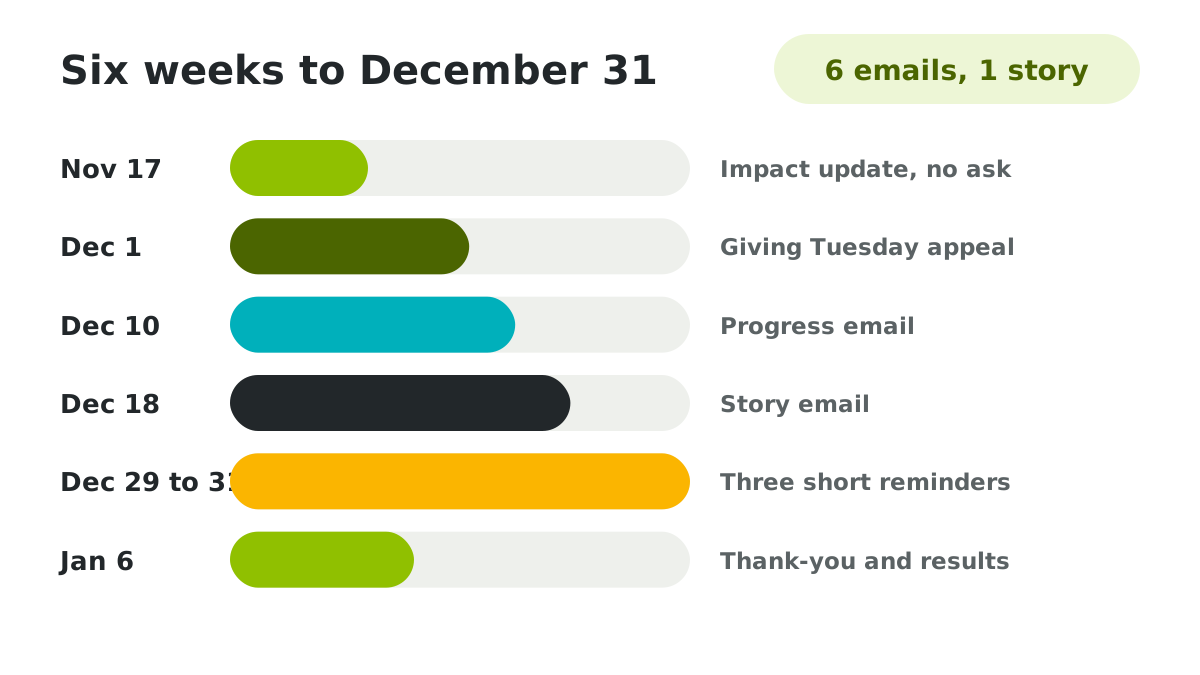
A literacy program that starts on November 17 might send an update about the reading circles in its first week, an appeal on December 1 for Giving Tuesday, a story email in mid-December and three short reminders on December 29, 30 and 31. That's six emails in six weeks, and none of them feels pushy because each one carries something new.
How to set one goal and one story for December
Pick one goal supporters can picture and one story that shows why it matters. A number tied to something real, such as meals, books or nights of shelter, works far better than a dollar target alone. The story should show one person and one change, told in a few sentences.
An animal rescue could aim for 150 spay and neuter surgeries before January and tell the story of Pepper, a dog who came in thin and frightened in September and went home with a new family in November. Every email, post and page then points back to Pepper and the 150 surgeries, so supporters see one clear picture instead of five competing ones.
Holding to a single story is harder than it sounds, because every program wants a turn. Save the others for the impact report in January, where they'll get the space they deserve.
Getting your giving page ready before the first email
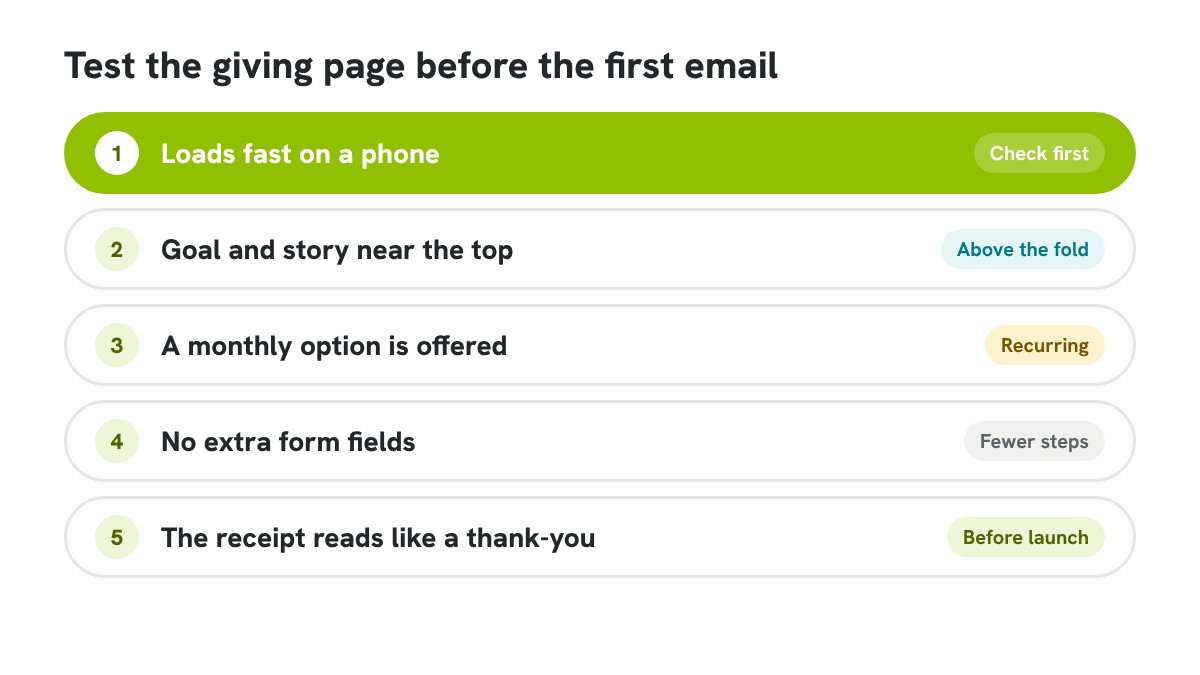
Your giving page should be tested on a phone, end to end, before any email goes out. Check that it loads fast, shows your goal and story near the top, offers a monthly option and sends a receipt that reads like a thank-you. Most lost gifts happen on the page, after the email has already done its job.
Ask a friend to make a small test gift while you watch over their shoulder. You'll spot the extra form field, the confusing button label or the receipt that arrives with no message. Fixing those three things in November is worth more than any subject line you'll write in December.
The email and social schedule from Giving Tuesday to December 31
The schedule below spreads six emails and a steady rhythm of posts across six weeks, with most of the effort saved for the end of the month. Each row is one checkpoint you can tick off as you go.
| Week | What goes out | Why it matters |
| Third week of November | An impact update email with no ask, plus two posts sharing the story | Supporters hear what their past gifts did before you ask for anything new |
| Giving Tuesday, December 1 | The first appeal email and a post on each channel you run | The day is already in people's calendars, so your ask rides an existing wave |
| First half of December | One progress email showing how close you are to the goal | A visible number gives undecided supporters a reason to act now |
| Week before the holidays | A short story email and two posts with a photo | A personal moment keeps the campaign warm through the busiest week of the year |
| December 29, 30 and 31 | Three short reminder emails and a post each day | These are the heaviest giving days of the year for most charities |
| First week of January | A thank-you and results email to everyone who gave | Closing the loop is what brings people back next December |
Plan your own dates with the timeline tool below. Pick your start date and the hours you have, and it builds a dated checklist you can copy into your calendar.
How a team of one runs the campaign in a few hours
A team of one can run the whole campaign in about two hours a week by writing everything in one sitting and scheduling it ahead. The heavy lift is a single afternoon in November, after which most weeks are about checking numbers and answering replies.
Block one afternoon to draft all six emails and the posts in one document. Write the appeal first, then trim it into the reminders and lift lines from it for social. Schedule every email in your email tool and every post in a free scheduler before December starts. A health charity that works this way can spend the holidays thanking people instead of writing to them.
The same habit carries into the rest of the year. If you want a weekly routine for after the campaign, the plan in our guide to marketing with a team of one picks up where this checklist ends.
Thanking supporters before the new year starts
Thank every gift within 48 hours and send a results email in the first week of January. A fast, specific thank-you does more than anything else to bring a first-time supporter back, and it costs almost nothing.
Write the thank-you message before the campaign launches so it's ready the moment gifts arrive. Name the goal, the story and what the gift will do. A youth sports charity might say the gift covers a season of cleats for one player. Add a phone call for anyone who gives above a level you choose, even if it's just a two-minute voicemail on December 30.
Then send the January results email to everyone, including people who didn't give. It tells them the campaign worked and reminds them you'll be back next year.
Common mistakes that cost small nonprofits year-end gifts
Most lost year-end gifts come from a handful of avoidable mistakes. Each one is easy to fix in November and almost impossible to fix in the last week of December.
- Starting the first appeal after mid-December, which leaves no room for reminders
- Telling several stories at once, so supporters can't picture what their gift does
- Sending people to a giving page that hasn't been tested on a phone
- Skipping the December 29 to 31 reminders because they feel repetitive
- Leaving the thank-you message until gifts arrive, which delays it by days
Repetition at the end of December feels awkward to the sender and helpful to the reader. Most supporters miss the first email, and the third one is often the one they act on.
Most supporters miss the first email, and the third one is often the one they act on.
Getting help with next year's campaign
A year-end campaign gets easier every year it runs on the same plan. Keep this year's emails, posts and results in one folder, write down what worked on one page, and next November you'll start from a draft instead of a blank screen.
Some teams want more than a checklist. They want the email series, the thank-you automation and the reporting built once and handed over so the campaign runs on its own each year. That's the kind of project mentored apprentices take on at Layer Cake Foundation, in kind, with a scope and a hand-over so it keeps working after the project ends. Whichever route you take, the habit that matters most is the same. Start on time, keep one story and thank people fast.